
V&A East’s ‘The Music Is Black’ Exhibition Arrives At A Crucial Time

Winifred Atwell’s ‘other’ piano, unrecorded date. Made by Chappell Pianos, object courtesy of Sir Richard Stilgoe. One of the items on display at V&A East’s inaugural exhibition, ‘The Music Is Black: A British Story’. Image courtesy of the V&A, London
The opening of V&A East and its inaugural exhibition ‘The Music Is Black: A British Story’ is a timely celebration of British identity and its cultural impact.
‘Underneath a radiogram on display at V&A East – those clunky dresser–like speakers that are the hallmark of a 60s house design – there’s an infographic that explains their importance for African and Caribbean families following WWII. These communities, often racially excluded from social spots and events, brought the party to their living rooms and back gardens, amplifying music through these radio and record players.
‘I can’t believe how normal that exclusion was then’ I thought, before moving through to the next part of ‘The Music Is Black’ exhibition, glad to leave that troubling piece of history behind me.
It was a jarring shock to find myself just a couple of days later, then, picking my way through the ‘Unite The Kingdom’ protesters in central London. Amongst the clusters of red and white and a thinly veiled agenda to bring back that racial exclusivity, a palpable sense of hostility lingered in the tube carriage. Coming face-to-face with that mindset, so open and unashamed, I thought again of that radiogram, and the risk of history repeating itself.
We’ll pretend not to notice the irony of the viral clip circulating of last weekend’s protestors playing ‘We Are The Champions’, sung by Freddie Mercury – a Tanzanian-born English immigrant, a child of refugees, and ¼ of a band that contributed (and still does) immensely to British culture and its economy. In fact, a groundbreaking report published in March by UK Music demonstrated that Black music has generated over 80% of the UK music industry’s revenue in the last 30 years. That’s a staggering majority… and yet, Black music is still frequently sidelined, underpresented, and lacking institutional funding, or even interest.
‘The Music Is Black: A British Story’ presented by V&A East in Stratford, aims to change that. It’s the largest ever exhibition on the impact of Black British music on the UK and around the world, and the museum’s first, in the building which opened its doors last month, designed by architects O’Donnell + Tuomey.
‘The Music Is Black’ is a celebration, and a warning. It’s about Black music, of course, but it’s also an eye-opening documentation of the historic pushback of Black culture and inclusion in British music and social spaces… and one that couldn’t be more timely. Read TOPNOTE’s review below.

Items including the Comme des Garçons outfit worn by Little Simz in 2023, and Stormzy’s 2019 Glastonbury vest, designed by Banksy. Inside V&A East Museum’s inaugural exhibition, The Music is Black: A British Story © David Parry for the V&A
The exhibit begins at the end of the 18th century, underpinning the lasting impact of British slavery and colonialism on the nation’s expanding power and wealth, and the oppression of Black African expression which continued to permeate in music as forms of rebellion and escapism. Moving briefly through the first half of the 20th century, there’s a particularly moving diary spread from Arthur Roberts (one of many African and Caribbean-descendant volunteers who fought to defend Britain in WWI), alongside photographs and stories highlighting the erasure of Black musicians who entertained troops across both World Wars.
The room opens up to a beautifully battered old piano owned by Winifred Atwell – the first Black British artist to secure a UK No. 1 single in 1954 with ‘Let’s Have Another Party’. At Atwell’s request, the visible impressions of fans who’ve carved their names into the instrument carts you back in time to smoky rooms and lively basement bars. You can almost see her ghost performing and hear the clinking of glasses as you listen to the music she played on it.
“‘The Music Is Black’ is a celebration, and a warning. It’s about Black music, of course, but it’s also an eye-opening documentation of the historic pushback of Black culture and inclusion in British music and social spaces… and one that couldn’t be more timely. ”
‘The Music is Black: A British Story’ was led by designer Sadeysa Greenaway-Bailey, alongside Sennheiser. Before entering the exhibition, you’re presented with motion-sensor headphones which are synced to each room, automatically playing snippets related to almost every exhibit you’ll come across. You’ll hear the music you’re reading about, listen to the artists whose outfits you’re looking at, and consume interviews in the voices of the portraits opposite. This is a true audio-visual experience that’s completely immersive.
The technology is remarkably smart, perhaps too sensitive. Though there are volume controls, there doesn’t seem to be a ‘pause/play’ button. You’re always listening to something, which can cause difficulties focusing on longer pieces of text. After an hour or so, you can start to feel overloaded with sensory input. The headphones react to every step and movement; sometimes turning your head or shifting your body weight will change what’s being played, and moving back will revert to the previous clip. When you’re trying to get a better view of something, or stepping out of someone’s way, you might find yourself listening to the same three clips in a messy tangle.
Whilst you can of course remove your headphones, it isn’t the smoothest movement since they’re attached to a phone-sized device hanging from your neck. It’s less an exhibition to spend hours and hours in, therefore, rather one worth revisiting, since there’s plenty to digest.
“This room is a sonic walk through history, laden with artefacts and stories. With every step, you’ll learn, hear, and begin to understand the technical and emotional evolution from reggae, to jungle, to garage, to grime. An hour could easily be spent in this curving path alone.”
Moving into the exhibition’s main room, the focus shifts to British music from the 1970s onwards; made by a new generation of Black Britons carving identities after a period of rapid post-war immigration. Particularly interesting are the boards outlining the progression of new genres – detailing their influences, defining instruments, messaging, and key artists or pioneers. This room is a sonic walk through history, laden with artefacts and stories. With every step, you’ll learn, hear, and begin to understand the technical and emotional evolution from reggae, to jungle, to garage, to grime. An hour could easily be spent in this curving path alone.
There’s a slightly confusing shift on exit to a clinically white room that jumps back in time, having more-or-less reached the current era in the last. Here, a brief gloss over Black British musicians reinterpreting traditional African nation musical styles in British contexts, and a two-dimensional collage of the few-and-far-between instances of Black artists landing front covers of music magazines over the decades.
The exhibition’s near-finale highlight is an impressive collection of outfits worn by 90s and contemporary Black artists. Most striking are Stormzy’s Union Jack stab vest worn during his 2019 Glastonbury headline performance (the first by a Black British male solo artist), as well as Skin’s ensemble worn for the slot in 2022 – the first Black woman to headline the festival with Skunk Anansie in 1999. It’s a shame these outfits aren’t displayed next to images of their real-life moments, though seeing the garments up close offers a sense of their wearer’s identities, particularly in the unflinching shoulder pads and grey khaki two-piece of Little Simz’ 2023 magazine front cover.
*
Music culture is embedded in political context. It will always be informed by the socio-economic factors it’s created in, consciously or not. ‘The Music Is Black: A British Story’ demonstrates the inescapable fact that so much of British music, even produced by white artists, is influenced, if not directly taken from Black cultures, first as a result of immigration, and then through a growing Black British population. As V&A East Ambassador Cat Burns summarises, the “focus on creativity for change really speaks to how music and culture can inspire, challenge, and create opportunity… It's about celebrating art, identity, and stories that matter.”
‘The Music Is Black is an imperative visit for lovers of British music – a feast for the eyes and ears. Its curators understand that visitors want to experience the sounds in the moment, providing a personalised, tailored, and intimate audio experience. Deeply enjoyable and educational, this exhibition arrives at a crucial time for a nation reckoning with its sense of identity and national pride, here to show that Britain’s ‘biggest cultural export’ is Black.
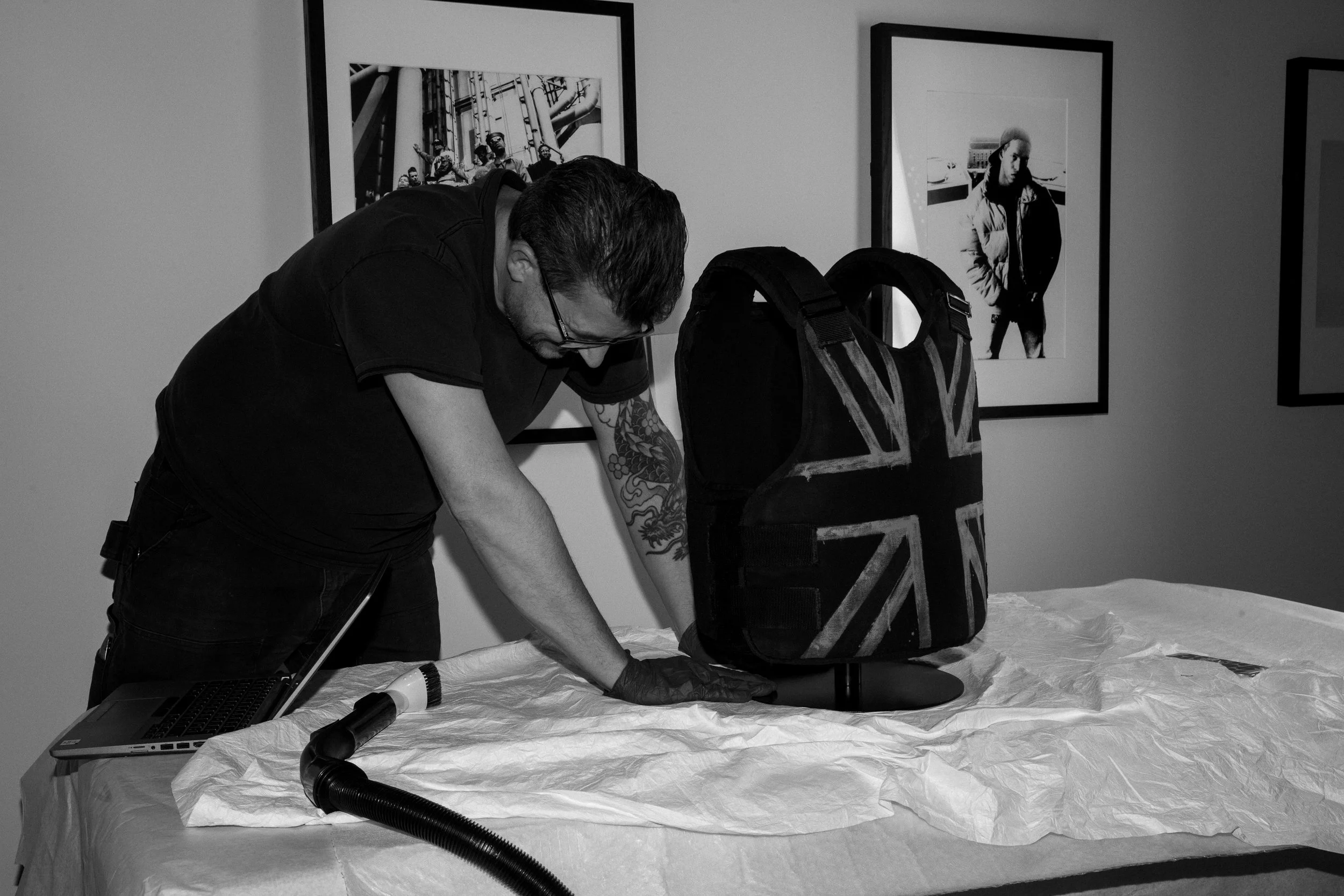
V&A East Museum team prepares Stormzy’s 2019 Glastonbury vest, designed by Banksy. Inside V&A East Museum’s inaugural exhibition, The Music is Black: A British Story. © Adama Jalloh for the V&A
V&A East Museum offers free entry to all, and is open 10am – 6pm Monday to Sunday, with late night openings until 10pm every Thursday and Saturday. Weekday tickets for ‘The Music Is Black’ exhibition are £22.50, with weekend tickets at £24.50 – but students and under 26 can attend for £11, and Art Fund tickets are available at £10. This exhibition runs until 3rd January 2027.