
Pigeon ‘OUTTANATIONAL’ Album Review: A Party Through Place & Identity
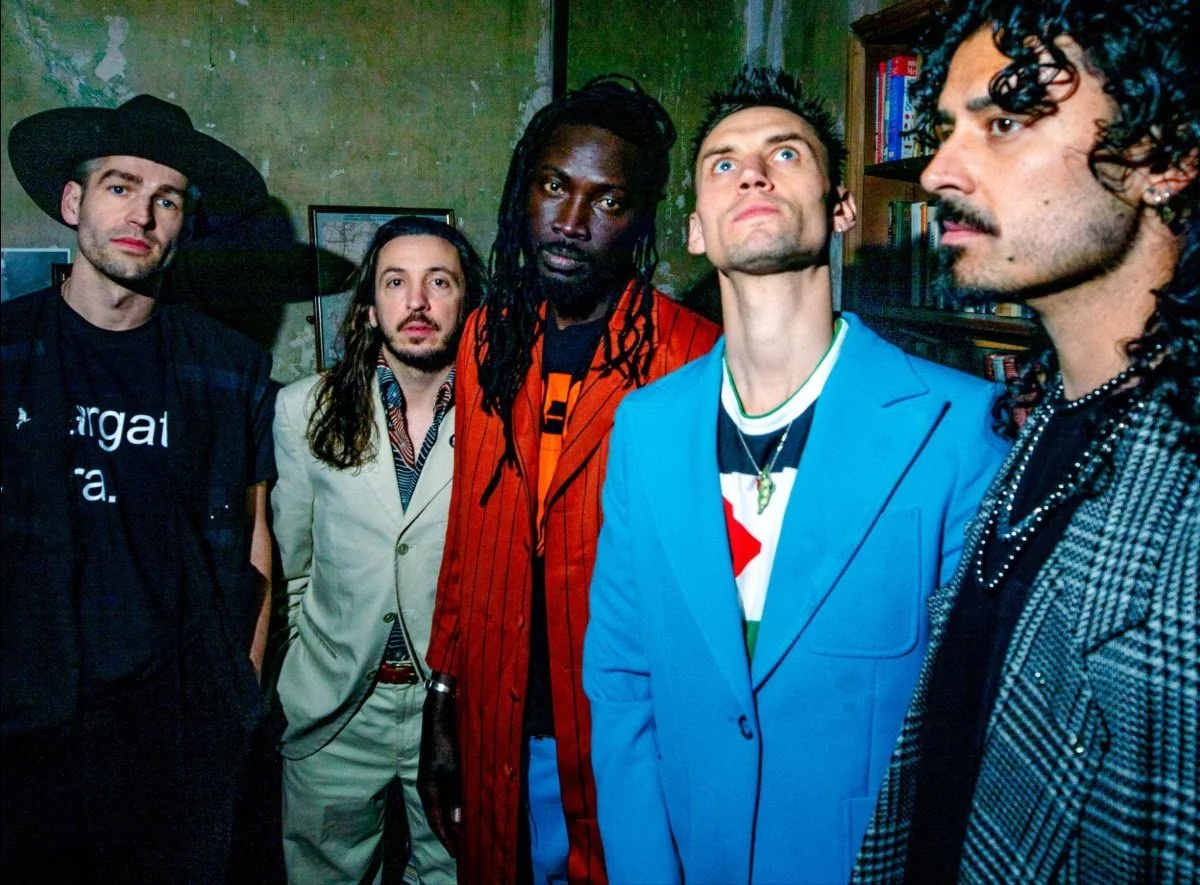
Pigeon released ‘OUTTANATIONAL’ on 1st May 2026. Image credit: James Winstanley
“I am the black James Dean… put me on your magazine!”
‘OUTTANATIONAL’ was written at a time of liminality, as a way to escape the internalised conflict surrounding what it means to be ‘home’. Pigeon’s lead vocalist/percussionist, Falle Nioke, was being naturalised in the UK after relocating from Guinea-Conakry in West Africa in 2018. The rigorous process necessitates exams designed to prove ‘knowledge’ of UK life and history. The Kent studios, where Pigeon’s first album was developed, offered a creative respite from the pressures of preparing for and navigating the personal and practical transition into British citizenship.
It might not sound like it on first listen… more something you’d put on at a party, expecting a tap on the shoulder, ‘hey…who’s this?’ And yet, a party is just a different kind of liminal, suspended space. A place where relationship structures are loosened, inhibitions are lowered, and each person in the room holds an innate knowledge that the exact ingredients of the evening can never be fully replicated. Designed for dancing, it makes sense that Pigeon’s first record encourages its listeners to take flight through movement, even if they’re not completely sure where they’re going.
Released last Friday via Memphis Industries, ‘OUTTANATIONAL’ is a dance through nations, identity and culture, between borders, and frequently beyond them. Read on for TOPNOTE’s album review.
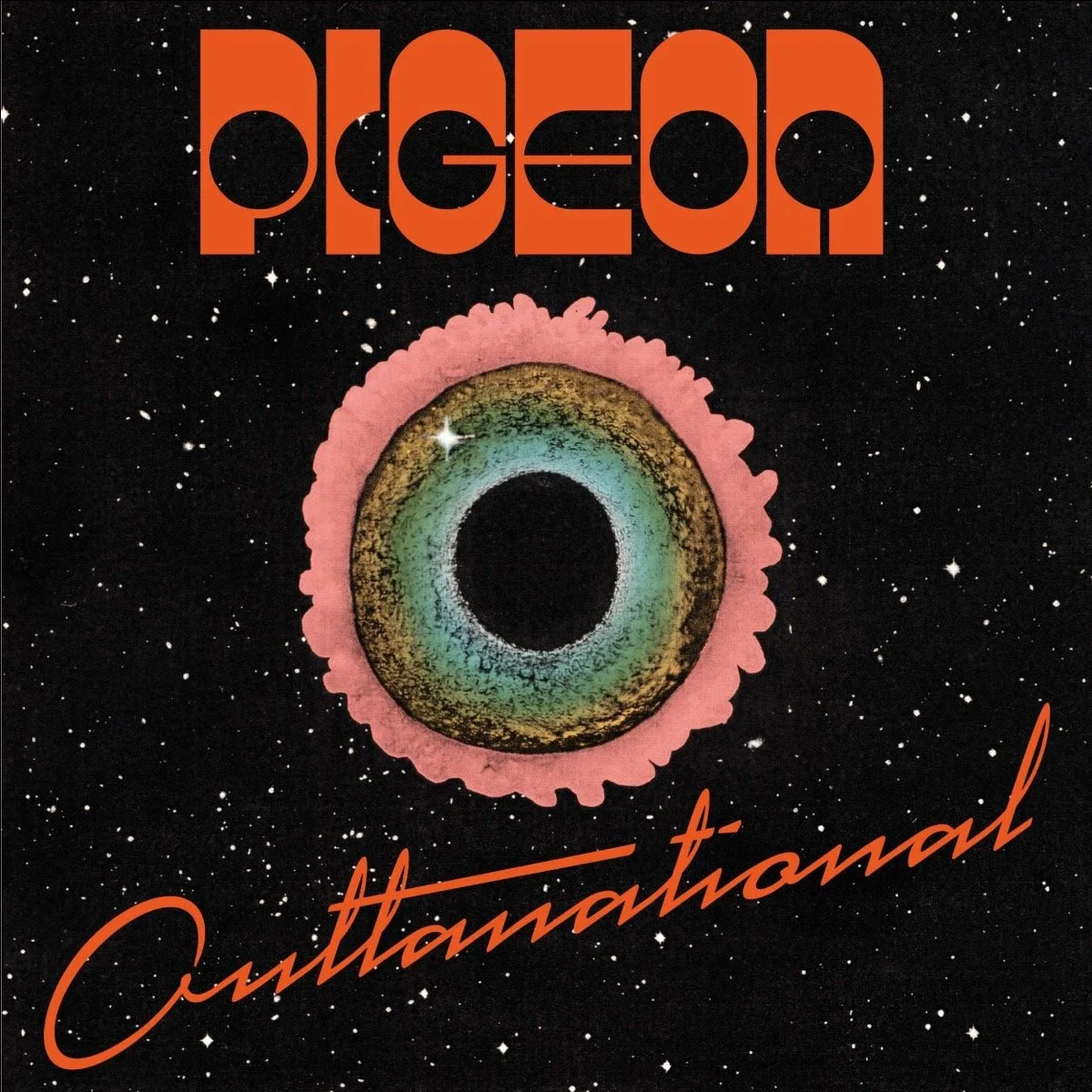
Pigeon ‘Outtanational’ album artwork. Image credit: Stay Golden PR
Formed alongside Graham Godfrey (drums), Josh Ludlow (bass), Steve Pringle (keys, synths) and Tom Dream (guitar), the individual band members have credits alongside Michael Kiwanuka, SAULT and Little Simz to name a few. It’s a fitting coincidence that the five musicians, themselves converging across influences and genres, were brought together by one of Britain’s best symbols of unity and national pride — a game of football. After a spontaneous jam session spurred from watching a losing match at the local pub… the bones of the Pigeon project were born. “The magic is the compass” drummer Godfrey described of the band’s music-making method.
‘NRJ’ opens up the world of cosmic and spiritual exploration… a steady moving, slowly rising rejuvenation of inner tranquillity. Across the record, Nioke sings in seven languages – French, English, Susu, Fulani, Malinke and Coniagui. Many of the tracks were recorded live through in-the-moment intuition, accompanied by traditional African instruments including the gongoma (a ‘thumb-piano’), the bolon (a bowl-shaped string instrument), and the cassi (a click-clack handheld shaker).
The album is sparsely decorated with words, prioritising chant-like phrases over verse-chorus structures. Most of the record’s story is told through its instruments. In ‘Black James Dean’ for instance, ‘I am the black gypsy / I am the black James Dean / put me on your magazine /…put me on your TV screen’ are almost the only English lyrics, though they’re repeated over and over. It’s precisely this which makes the song so interesting, that singular phrase moving from cool and confident, to desperate and agonised, to powerful and confronting.
“‘OUTTANATIONAL’ is a dance through nations, identity and culture, between borders, and frequently beyond them. It’s a fitting coincidence that the five musicians, themselves converging across influences and genres, were brought together by one of Britain’s best symbols of unity and national pride — a game of football.”
The comparison to the iconic figure of teen rebellion in mid-century America, interspersed with segments in African languages, is brought to a head in the murky bridge: ‘We wanna travel like our ancestors / …So please don’t stop us doing our culture’ and an inferred refusal to conform to contemporary conservative America’s homogenised ideals of society. In the album’s best track, Pigeon are providing a heads up. They’ll keep striving forward, whether or not you wish to recognise it. Sooner or later though, you’ll have no choice.
It’s straight into a neon 80s arcade next, from Margate to ‘Miami’, with a determined imagination that curates a glittering beach scene which toes the line of camp, especially in its YMCA-style bridge. One of the record’s most alluring tracks, ‘117’ is a spiritual, motivational mid-point, which will leave you wondering… Is it a bus route? Is it a postcode? Is it even a real number? ‘Follow the numbers, 117…’ Nioke echoes, before the swirling chorus repeats it, phasing out into a milky-way twist on Gerry Rafferty’s ‘Baker Street’ saxophone riff. Intentional or not, Rafferty’s iconic song depicts the disillusionment and loneliness experienced after his own move to London.
The self-described ‘mutant disco’ ‘Mirror Test’, a hybrid of Mildlife & Grace Jones, brings some welcome lift as we drift to the latter half of the album, but new single ‘Future Country’ provides a chilling note to a largely optimistic album. ‘Will they want me in the future country? / Will they need me in the future city?’ the band ponders over a janky chorus. It’s an intentionally sonically jarring peek into the unravelling anti-immigration rhetoric, more haunting for the song’s simplicity.
“Layered with a contemporary Western band sound, it sits between the West African griot tradition of storytelling threaded down from ancestors, and the instantly gratifying, fast-moving nature of Western pop. The outcome is an album that’s ‘OUTTANATIONAL’ – belonging to many cultures and none, with a side-scoop of psychedelic space funk.”
Despite this moment of conceded anxiety, the overall perception of ‘OUTTANATIONAL’ is of a person moving through time and space, prioritising their own interpretations and protecting their peace. Inherent in the album’s closing tracks is the band’s guiding motto, ‘pigeon must fly’, borrowed from the Guinean singer’s nation. For him, pigeons symbolise freedom and prosperity. ‘Today Is Another Day’ looks to the future with brightness and optimism, while ‘Caramel’ is a soft prayer of gratitude to Nioke’s ancestors. “Now I’m pleased to be part of both homes. One side is Africa, the other side is here.… No matter the obstacle, we have to fly.” Nioke says, reflecting an album that ends much more grounded than it begins — a journey complete.
*
Pigeon’s album can easily act as a backdrop for parties, driving the energy of a room with its inviting groove and ever-present rhythm. It can also be listened to in the car, on a train, on a walk – with full attention and plenty of details to be ingested on each spin.
Layered with a contemporary Western band sound, it sits between the West African griot tradition of storytelling threaded down from ancestors, and the instantly gratifying, fast-moving nature of Western pop. The outcome is an album that’s ‘OUTTANATIONAL’ – belonging to many cultures and none, with a side-scoop of psychedelic space funk.